
Aidalee has made it her mission to level every character in “Heroes of the Storm” (our favored MOBA) to level 999 (or whatever the cap is). Needless to say, we’ve destroyed a lot of Nexuses (Nexi?) in our day. I was so happy to see that a tabletop MOBA existed that I reached out almost immediately and requested a copy. To that end, special thanks to Skytear Games for sending a copy for coverage / review purposes.
—
What is a MOBA?
A MOBA (or Multiplayer Online Battle Arena), is a computer real-time strategy game that typically pits two teams of five against each other. Each team’s goal is to reach the enemy nexus and blow it up. Uncontrollable minions automatically spawn on each team to help player controlled heroes push down two or three separate lanes guarded by towers from each team. Whether it’s “League of Legends”, “Heroes of the Storm”, or “DOTA”, player controlled heroes are diverse and fill many different roles.
Note for the well versed: Like “League of Legends” and unlike “Heroes of the Storm”, “Onward” will allow players to buy gear from time to time using money that they earn.
—
(Miniatures sold separately)
—
Game Overview
Players choose one of the two maps to play on (the board is double-sided) and split into team if you have more than two players. Players / teams also receive a total of four heroes, one of each of the character colors (red, blue, green, yellow). They can use the recommended first-game characters or draft them. Each character has its own unique deck of cards including an ultimate, so you’ll combine those cards to form a deck (the ultimates go in the discard pile to be shuffled in later). There’s a lot more to setup so I’ll refer you to the rulebook.
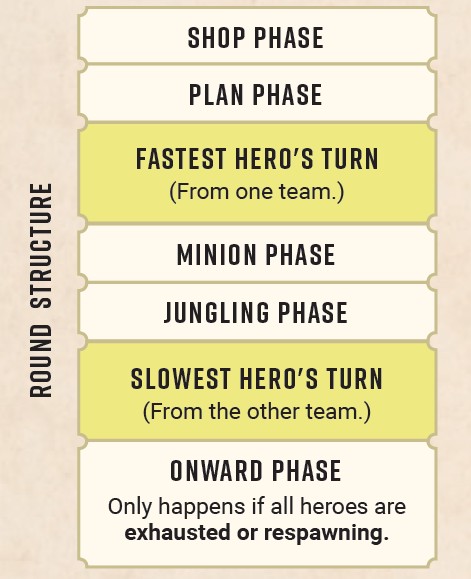
The game is played over five in-game days, or until someone’s nexus / core is destroyed, whichever comes first. Each day consists of a series of rounds. Rounds look a little something like this:
—
—
Without getting into the nitty gritty, players start by buying gear in the Shop Phase and play a card onto a ready hero in the Plan Phase in priority order. Players simultaneously reveal their plan card and whoever has the faster speed takes the Faster Hero’s Turn. Ties are broken via the priority token, but said token is flipped so that priority is now gained by the loser of the tie.
Minions spawn and compare their momentum with opposing minions’ momentum, with the side with greater momentum able to attack and kill / destroy opposing minions and towers in order to push down their lane. All neutral monsters, player minions, and player towers only have one hit-point. It’s hard to summarize a whole page and a half into a few sentences, so again I’ll refer you to the rulebook. Luckily, the next phase (Jungling) is easy in that players just automatically attack and kill neutral monsters in their space, assuming they have more heroes present than their opponent. Killing monsters grants players money to spend in the Shop Phase.
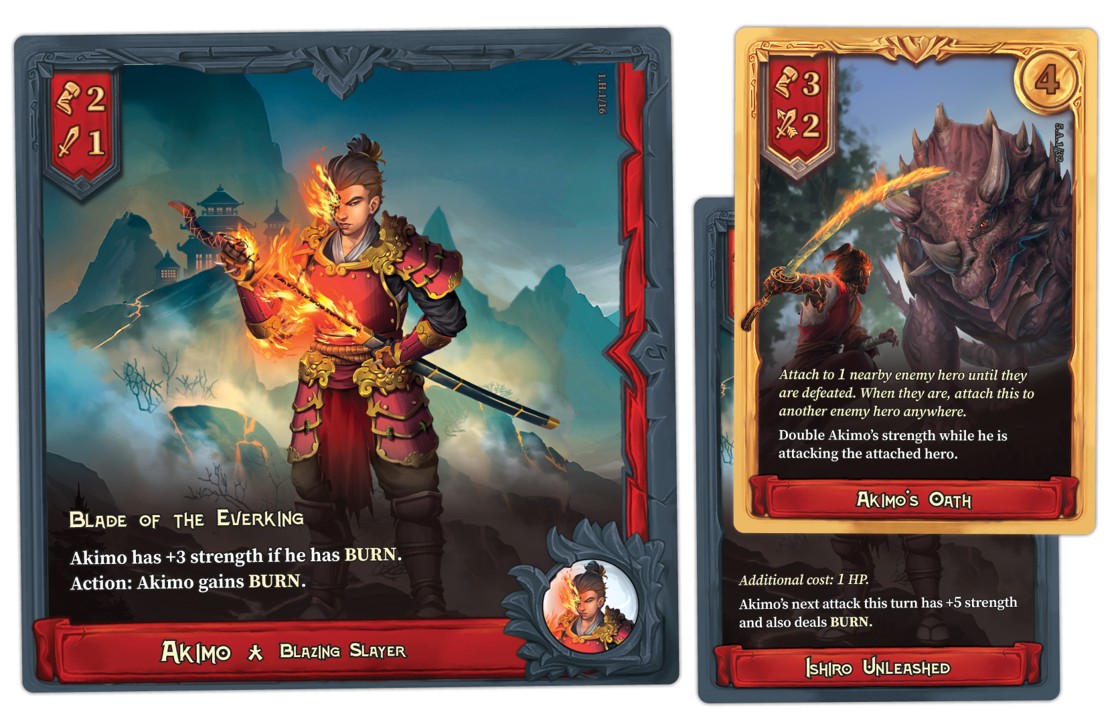
Player turns are also long-winded, but essentially the active hero will spend their movement and attack points to do things. Players can use the plan card’s stats, or the inherent stats on the character cards (called the backup plan). Some characters have special abilities that activate during certain times, and the opponent can react to each move / attack / spell / thing the active player does if they have a flash card. Attacking heroes in almost any way involves drawing from the player deck and looking at the damage listed in the upper right.
There’s retaliation. There are spells. There’s more…but my wrists hurt so I’ll stop there with the overview. In case I haven’t emphasized…
RULEBOOK: https://shop.playskytear.com/en/onward/resources/
—
—
Review
Kudos. That’s how I’m starting this review. Kudos. It takes both imagination and guts to adapt a popular and somewhat exclusive video game genre to the tabletop world. I can honestly say that I don’t own any tabletop game like this. From a purely tabletop product perspective, this is a unique and rather niche game. I love it when developers create something new rather than carbon copy popular games before it. The game includes a whopping sixteen heroes, so you’re going to see a lot of variety in the games you play. Don’t forget, each character has their own unique six card deck including an ultimate. I love that the developers included a two-lane board on the reverse side of the typical three-lane board.
As excited as I was / am to play “Onward”, I do have to warn potential buyers that this game is a commitment with average play times hitting two hours, at least that’s been our experience. It is honestly much faster for us to boot up “Heroes of the Storm” to get our MOBA fix. I write this not to dissuade you from buying it, but to set expectations. Luckily, if you’re more of a tabletop gamer who doesn’t play a whole lot of video games, “Onward” will allow you to experience what a MOBA feels like in a relatively streamlined manner. On the flip side, veteran MOBA players will able to catch on to the rules rather quickly, but it’ll take some time to acclimate to this particular rule set and the character abilities.
I in particular had trouble my first game deciding which hero to activate and why. Some are melee and some are ranged, so you have to time them differently. Things happened much more quickly than I expected to, mainly in part to everything but heroes having a single hit-point. This lead to me second guessing myself constantly as it seems like you really have to be efficient with your turns. The rulebook says that the average game lasts three days and there’s only four actions per day (one per character assuming they’re not defeated).
The shop mechanics are a nice and welcome touch. Each hero can have one item of each of the four colors. Being a “Heroes of the Storm” player I’m honestly not used to it (but remember enjoying the concept in “League of Legends” when I played ten+ years ago). A gold mechanic makes players choose whether to lane push for an early win, or concentrate on neutral monsters for gold.
There’s also an outsider creature that shows up at the beginning of day two…it’s a powerful neutral mob that gives boons to those who kill it. It has five health though, making it a commitment. I found this addition to the game surprising and welcome…reminds me of the bosses that show up in “Heroes of the Storm” that give a huge bonus to those who slay it. Speaking of “HOTS”, it would have been cool if there were special events or conditions that pop up from time to time…though instead of it being map specific, perhaps from a deck of cards drawn at random for each game.
I would have loved a co-op mode, as that’s what I play exclusively on the video game side of things. I refuse to PVP and ARAM (All Random, All Mid) as I absolutely abhor the toxic potential of these game modes. I may have to attempt a home-brew someday. I’d also be keen to see about a single-lane map, which is fairly common in the ARAM scene.
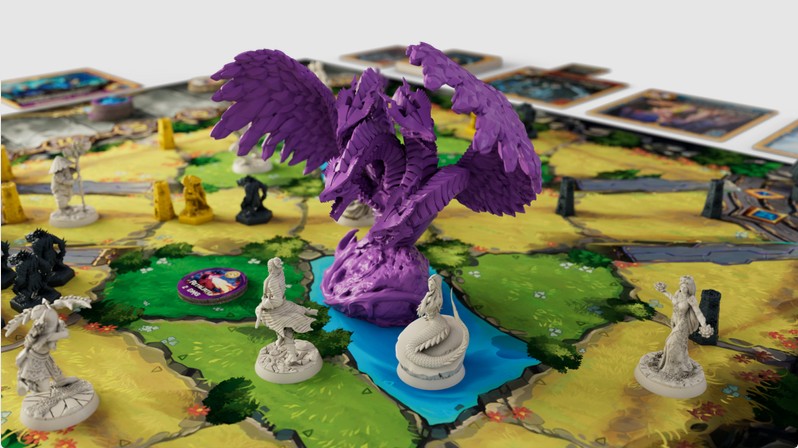
I’m saddened by the lack of miniatures…every character, minion, and tower is represented by tokens and cardboard cutouts. I wish I could spend the $175+ for the box of miniatures on the official website, but that’s the cost of my gas and light bill combined on a good month. I understand the cost in including minis in games like this, I’m just disappointed by the tokens as it took me out of the immersion a bit.
Aidalee had a bit more of a negative take. She was quickly frustrated by all the little rules and had a hard time piecing it all together. I partly blame myself for not explaining it well though as a new player I was struggling myself in a few areas. She applauded the MOBA theme and the art, but disliked how persnickety the rules can be at times. She lost on Day 2, unaware of how deadly a strong minion push could be.
There’s much more to talk about, but I’ll sum everything up by saying that it was a joy to play (on my end of it). Replayability is high, the component quality is high, and there’s plenty of expansion content available to keep you busy for a long while. The learning curve is somewhat on the high side, but less so for experienced MOBA players. Lots of little finicky rules (it could have been worse as they streamlined certain areas) make it more likely you’ll mess up a bit your first few plays. That said, “Onward” is a game I’m happy to be bad at.
As a bonus, the game is available on Tabletop Simulator so that you can try before you buy. I feel like this game would appeal to a fairly niche kind of audience and it just so happens that I’m within that wheelhouse, but your mileage may vary. I highly recommend demoing the game first to see if it speaks to you.
—
Score: 7/10 (Good)
—