
I grew up a Chess player. Sure, I had access to games with dice, but I much preferred abstract strategy games over games of chance. “Ruthless Junctions” is an abstract game that doesn’t have dice…instead, you’ll be placing tiles on a 7×7 grid trying to create chains while trying to stop your opponents from doing the same. Special thanks to Game Designer Mark McQuillen for sending a copy for review purposes. I’m required by FTC regulations to disclose that I was paid to cover this game, however any and all opinions remain my own. The only thing paid for here was my time and expertise.
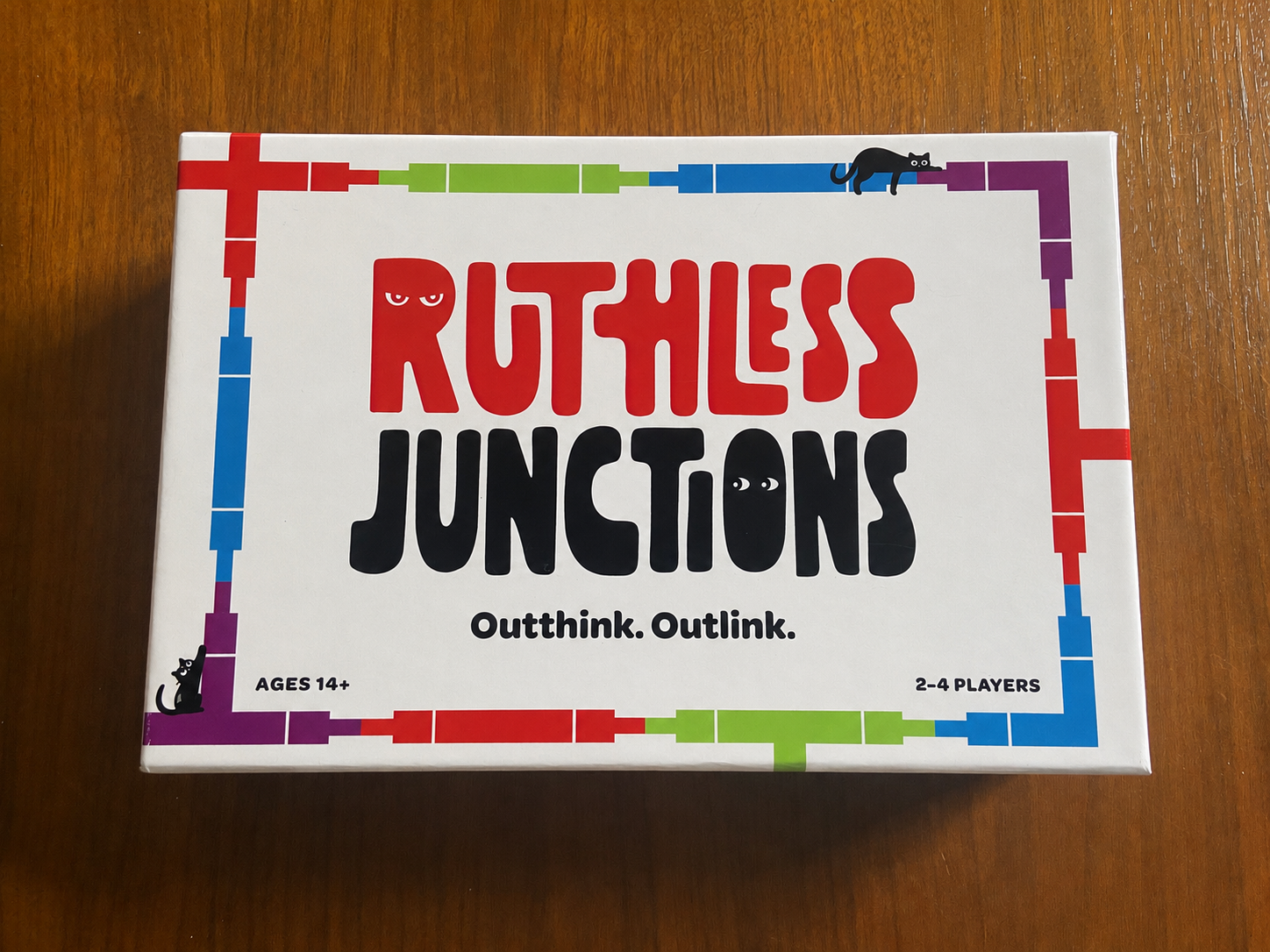
2-4 Players, Ages 12+, Average Play Time = 30-45 Minutes
*The physical box I received stated 12+. This review was filmed before The Game Crafter adopted its current 14+ marketplace labeling policy.
—
Overview
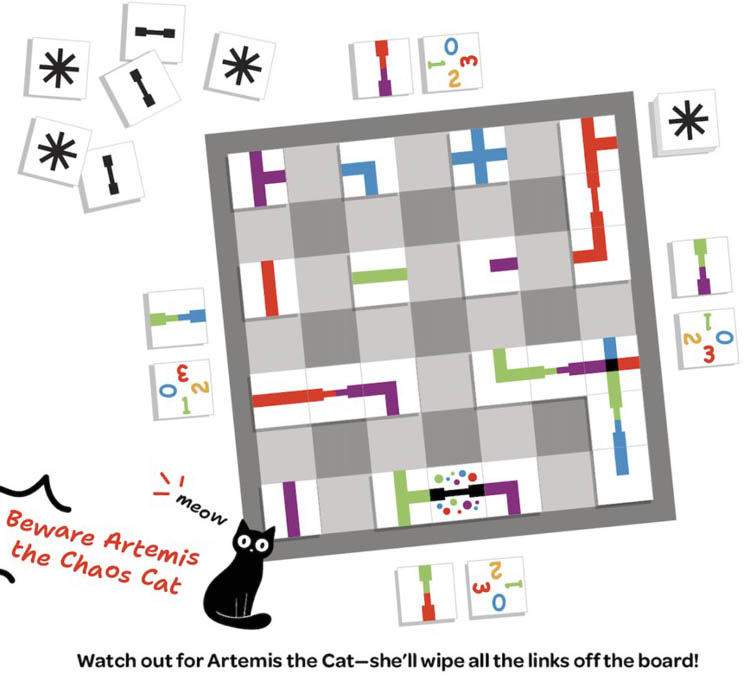
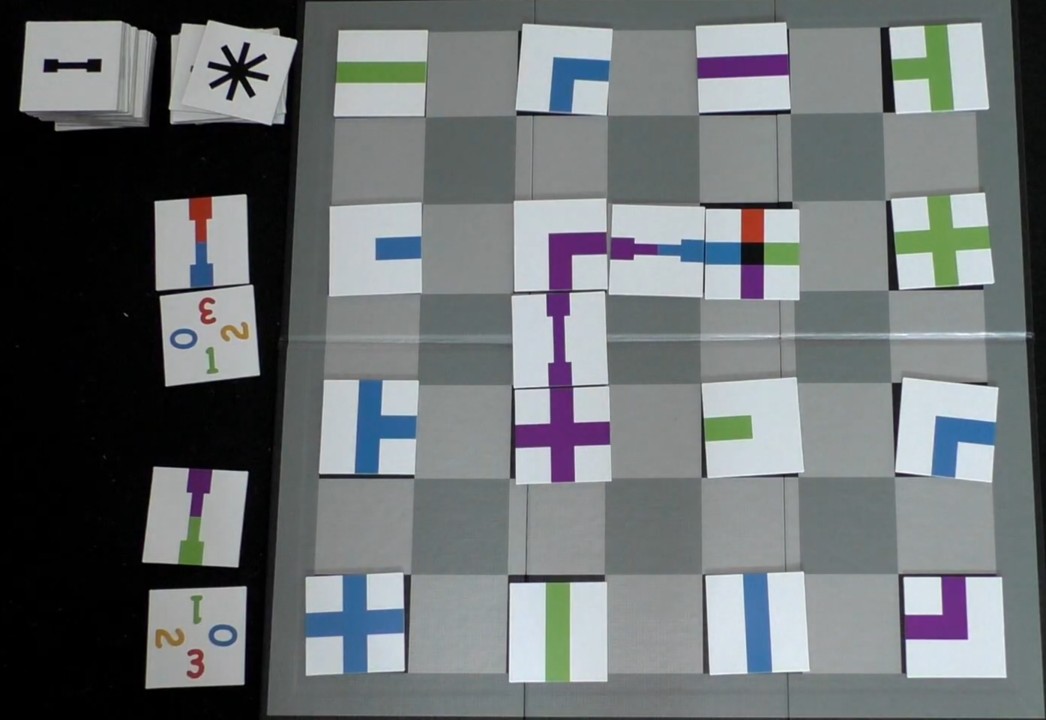
The game consists of 1 7×7 game board, 28 junction tiles, 30 link tiles, 2 multi-color junction tiles, 1 wild link tile, 4 count tiles, and 1 cat tile. 1 count tile is given to each player and the rest are discarded. Players then mix up the rest of the tiles face-down (called the Scramble). Players then fill the 16 black squares on the board with junction tiles (they have an asterisk on the back), then flip them face-up ensuring the tiles are oriented randomly. A start player is determined via tile picking, but you can honestly just choose one to make it easier. Finally, each player draws a link tile and places it face-up in front of them.
The object of the game is to have the most points. The game wraps up when someone hits 50 or more points, with players who haven’t had an equal number of turns making their final turn. Players earn points by connecting two junctions with a link tile, earning a point for every tile in the chain they created or extended.
Players take turns in clockwise order, and on a player’s turn they can take a total of 3 actions. The count tiles allow players to keep track of how many actions they’ve taken for a turn.
There are 6 different ways to take an action:
Junction Tiles – Players can rotate a junction 90 degrees, perform a scramble swap (remove a junction from the board and replace it with a new one from the scramble pile), or perform a buddy-swap (swapping two junctions next to each other on the same row or column).
Link Tiles – Players can place link tiles connecting two junctions then draw a new link from the scramble (limit 1 per turn), scramble swap (place your link tile in the discard pile and draw a new one from the scramble), or remove a link from the board and discard it. To create a proper link between two junction tiles, the colors of the junction and link ends must match appropriately.
Note: Should the scramble run out of tiles, you’ll reshuffle those in the discard pile.
There is a cat tile and his name is Artemis the Chaos Cat. When drawn, all links are removed from the board (junctions stay put) and placed into the discard pile along with Artemis. The player that drew the cat tile can draw again.
When someone creates a valid connecting between two junctions, points are recorded and a running tally is kept. Turns continue until the game ending condition previously mentioned above is reached.
The above doesn’t cover every rule found on the rules sheet, but should give you an idea as to how the game is played. You can read the entirety of the rules here:
https://www.thegamecrafter.com/games/ruthless-junctions
—
—
Review
“Ruthless Junctions” has quite a bit going for it, though I feel like for every positive can potentially be a negative. Allow me to explain.
Let’s talk about the number of actions you get per turn. It’s great that you can do all sorts of cool things like scramble swap, place links, rotate…it gives turns a decent amount of flexibility so that players can come up with some really cool chains and combos. On the other hand, this opens the door for a lot of downtime for players who have to wait for someone to think it all through. While not in the rulebook, I recommend a turn timer for competitive groups to help ease this decision paralysis problem.
Games tend to be highly interactive, which can be both good or bad depending on your preference. Some folks like cutthroat blocking and tense “take that” style turns, while others prefer to work out their own little puzzle without being messed with. This particular game leans heavily toward the former, with players often feeling like everything they just did can be reset by an observant opponent. If you’re not into sabotage / take-that style gameplay, then this title may not be for you. I’m looking at you, “Alhambra” lovers.
One positive that I can be sure has no opposition is that this game rewards critical thinking. Much like a Chess Master being able to outplay a beginner by thinking several moves ahead, “Ruthless Junctions” rewards those who can make the best moves and see combinations others miss. The actions WILL take some getting used to at first, so expect a learning curve for your first couple of games. That said, it’s not all strategy…
There’s a luck element too, especially when you start swapping out junction tiles. Swapping out link tiles makes sense when there’s clearly nothing there for you…but swapping out a junction is a free for all. You never know what you’re gonna get unless you’ve been counting and even then, you’ll probably help your opponents out without meaning to because the new tile favors them. I feel like swapping is a good first action when necessary, so you can spend your remaining two doing damage control if things go bad.
—
—
I’m going to say what I always say when reviewing a game sold on “The Game Crafter”. TGC is not a bulk / mass-producer but rather makes custom-made objects to order. As a result, component cost is incredibly high. I understand why the game is $61.99 on TGC, but as a consumer I would never pay that price for a game of this caliber. Talking about this always sucks, because consumers don’t typically care about how things are made…they just want the best deal comparable to what’s out on the market now. Those invested in the industry like myself however are familiar with the other side of the coin. You’ll have to decide if $61.99 is right for you, but hopefully the developer can find ways to bring that down. Way down.
The component quality is great, which probably explains the high price on TGC. The tiles feel great, though the board is a bit on a flimsy / thin side. The rulebook is an easy read too. It helps that this game is similar to others I’ve played before. “Ingenious”, for example, has you matching colors to score with a focus on spatial piece laying. “Tsuro” has you creating paths in a somewhat “take that” setting, and “Blokus” has a lot of territorial blocking. “Ruthless Junction” doesn’t exactly break any ground-breaking records when it comes to unique gameplay mechanics, but it does what it does fairly well.
It would be interesting to see a variant where you have a hand of link tiles, rather than just the one. It would give players more options, but would probably create a lot of downtime as players struggle to find the best move. I think a more peaceful mode would be cool…that is, preventing others from removing links you’ve placed. You’d have to use colored markers to keep track of who laid what, but it is doable. A lot of games I play have secret objectives that may or may not work here too. A secret objective might force players to make plays they normally wouldn’t make to earn some points, keeping things fresh and unpredictable.
“Ruthless Junctions” is a highly interactive, punchy, and re-playable tactical tile-laying game. It will attract those who love puzzling out their next move, but may frustrate those who hate being messed with as they attempt to put their chains together. This game is half as much of a personal puzzle game as it is a “mess with your opponent” game. In fact, the latter is highly, highly encouraged. The developer hinted at a possible crowdfunding project in the future, which I think would hopefully solve TGC’s high pricing issue.
—
Score: 7/10 (Good)
—
Buy: https://www.thegamecrafter.com/games/ruthless-junctions
—