
Some of the best card games in history first started as a standard deck of 52 playing cards, evolving over the course of time. I’ve seen all sorts come across my desk…some were great, some were not. “Fano”, I’m pleased to say, is certainly one of the more unique I’ve seen. It takes inspiration from the very real “Fano Plane” and yes, I had to look that up. Luckily, you won’t need a degree in whatever migraine-inducing math the actual concept requires in order to play this card game. Special thanks to Game Creator / Designer William Hansen for sending a copy for review purposes. I’m required by FTC regulations to disclose that I was paid to cover this game, however any and all opinions remain my own. The only thing paid for here was my time and expertise.
—
1-4 Players, Ages 7+, Average Play Time = 20-40 Minutes
—
Overview
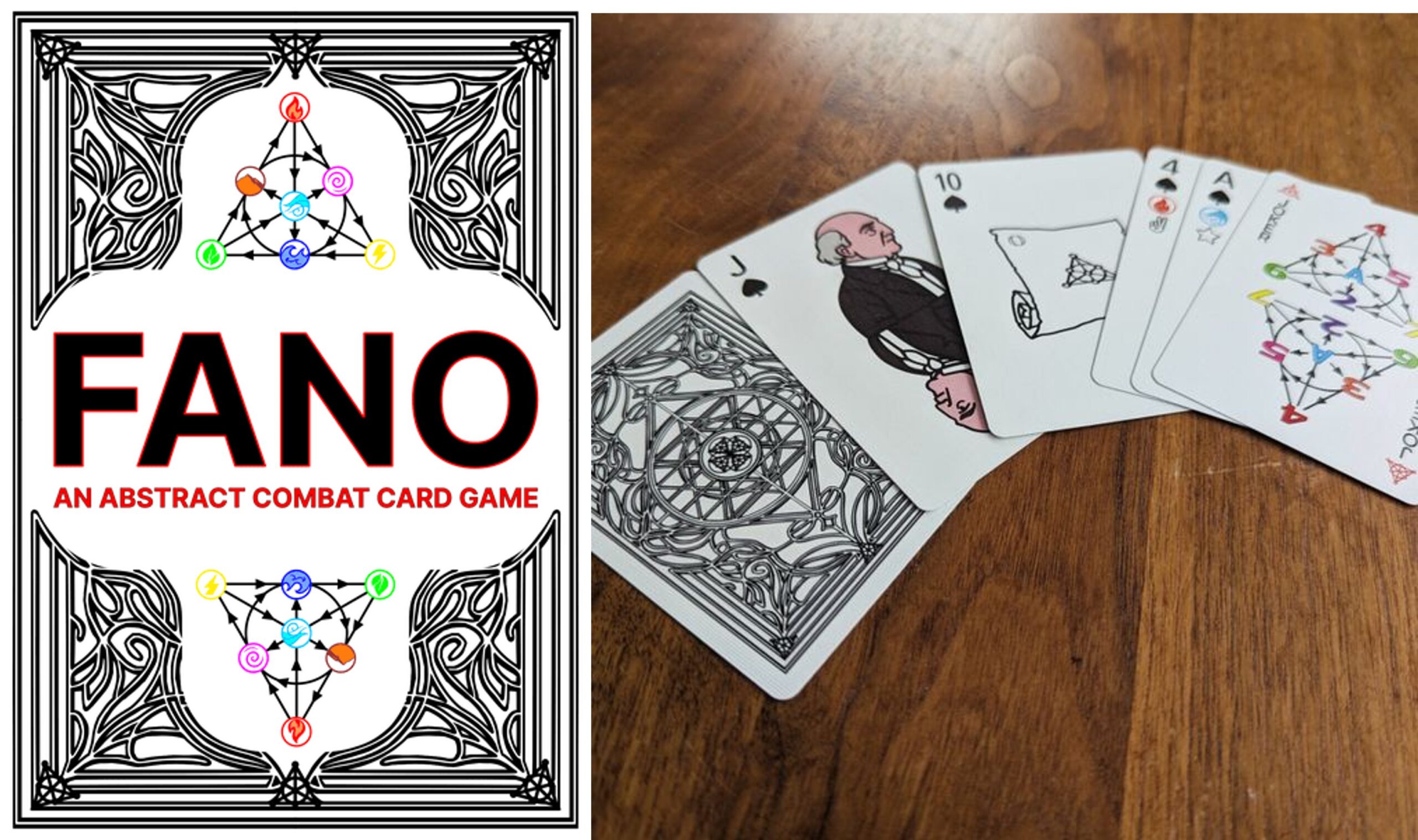
Players have a Commander (J,Q,K) and a deck of number card ranging 1-10. Their Commander starts as a Jack, with the ultimate goal of promoting to a Queen, then a King. Promoting one last time as the King wins the game. The 8, 9, and 10 (Artifacts) help you promote / prestige your commander, while the 1-7 (Element + Number = Elember Spells) cards focus on combat and other duties. The 1-7 cards have a rock-paper-scissors relationship with each other.
Aside from a Commander and a deck of cards, players also have a field in front of them that can hold up to 4 of their spell / artifact cards. They also have a discard pile.
To setup, players choose a faction (Spades, Hearts, Clubs, or Diamonds), place their Jack/Queen/King in a stack face-up with the Jack on top, and shuffle their 10 card faction deck to form their draw pile. Players choose a starting player at random.
On a player’s turn, they’ll perform the following:
1. Draw up to 3 cards (max hand size is 3). If the draw pile is empty, the discard pile is shuffled to form the new draw deck.
2. Barter (optional). This involves taking two artifacts from hand and discarding them in order to draw a card.
3. Bonus Actions (unlimited). These can be to Redraw 3 cards if you have none in hand, discard 3 artifacts in your field to Promote your Commander, Combine two cards in the field and discard term to bring out a card from hand of that sum, Recruit a card from hand that shares the same Fano cycle as two cards in your field, and Attack an opponent’s card in their field forcing a discard.
4. Main Action (choose 1). These involve playing a card into your field, substituting a card from your field to play a card from hand, discarding any number of cards face-down into the discard pile, or passing.
It’s worth mentioning that there’s slightly more to some of these rules / actions. I included a link to the rules and online tutorial below.
Rules: https://playfano.com/instructions
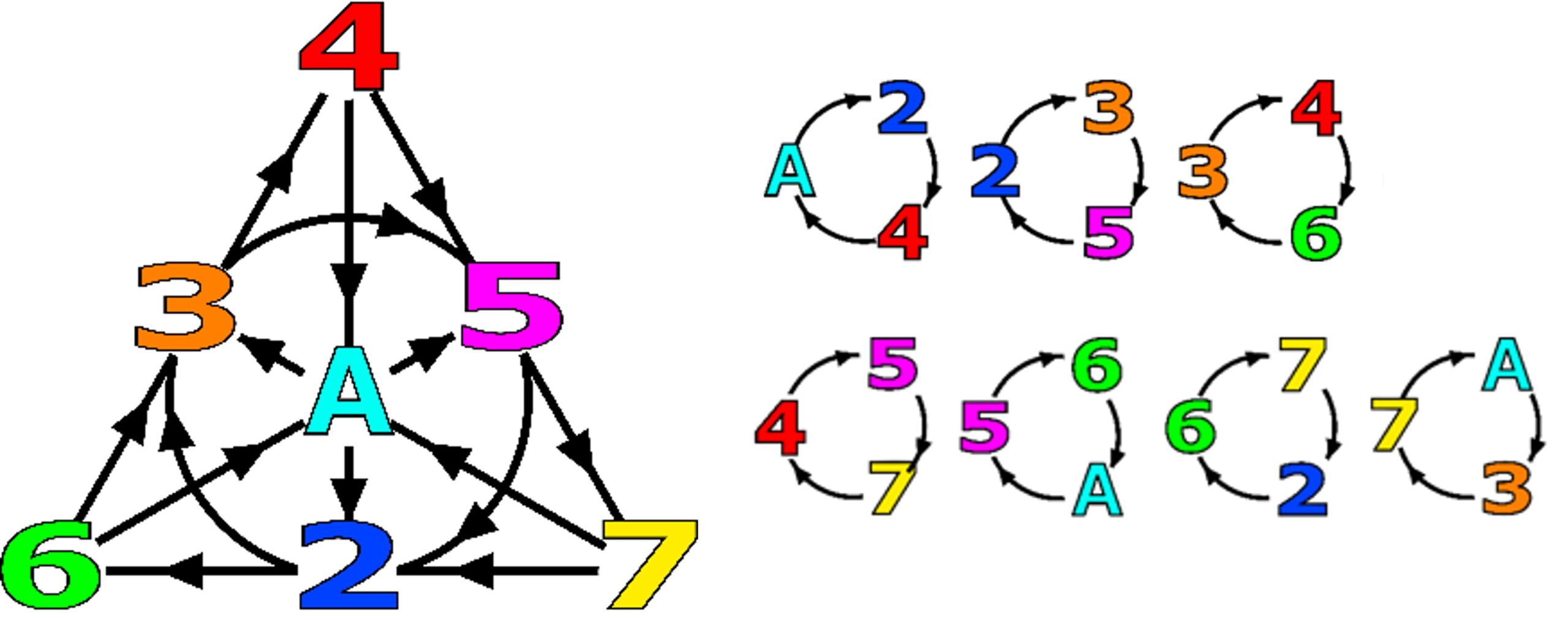
The main concept I do want to convey however is how the combat cards interact via the Fano Cycle. When attacking an opponent’s card, you’ll be using two cards total. The attack card that points to the target card will come from the attacker’s field, while the attacking player’s support card will come from hand. In the example of A-2-4 below…Player 1 wants to attack the 2 on their opponent’s field. Player 1 will activate the A from their own field, then play the 4 support card from hand. The A and 2 would go into their own respective discard piles, while the 4 support card moves to the attacker’s field.
There are other concepts that involve triggered actions…being able to counter cards being attacked and so on. I’ll let you discover these on your own so as to keep this review at a respectable length. See the rules linked above for details.
—
—
Review
“Fano” has quite a few things going for it. For starters, most card games that come across my desk fall into a category that I have seen before. For example, trick-taking and poker are two of the top themes I’ve seen having done this for over ten years. “Fano” doesn’t do that. Its theme is incredibly unique, drawing on a mathematical theme of the same name to drive its core gameplay. It’s incredibly refreshing to see developers think outside the box instead of recreating “Sorry” or “Poker” for the umpteenth time.
The combine mechanic is a good one. I glossed over it above, but essentially it encourages players to think ahead. Oftentimes you’ll have a choice between playing one of two or three cards out onto the field. Since combining cards involves summing the two discarded cards from the field to play one from hand, you’ll have to do a bit of math and planning. It’s the only way to get your 8, 9, and 10 cards out to promote your Commander and win the game, so combining is integral to the strategy.
The 1-7 cards are multi-use, which is another plus. A card can be an attack card, a support card, be used for combining, be used to recruit, and more. To that end there’s a bit of a learning curve associated with this game…I admittedly didn’t know how to think ahead at first or how best to use cards and when. Decision paralysis is strong with this one.
The attack system is interesting too, because the support card ends up on the field which can be either good or bad depending on what your opponent had on their field. There’s an underlying layer here that I glossed over as well involving counters and critical attacks. While not in the rule cards, it might be wise to try house ruling those out until you get the basics down. I feel like as a beginner, the game is overwhelming enough at first glance.
That brings me to what I didn’t like. I feel like the game’s biggest problem is the high learning curve. Players are expected to grasp all the different ideas and rules all at once. I imagine some people in my family (casual gamers) throwing their hands up and opting to play something simpler instead. Even as an experienced gamer, I had to refer to the rule cards / online rules regularly. I spent half my time away from strategy (what I should be focusing on) just to understand how it all ties together. It’s one of the reasons I suggested house ruling out the counters and critical attacks.
In fact, the rule cards in the box are a bit too vague in certain areas. The promote action on the rule cards has a bit about keeping a card and rotating it 90 degrees (???) but the official website directions don’t mention that at all under the promote section. New players should not have to hunt for an FAQ and rule clarifications on the official website, which admittedly explains things a little better. The developers tried to cram the rules of a complex game onto two rule cards and as a result, spread the rules too thin in some areas. In my opinion, a game should be completely 100% understood from the rules listed in the box. No online tutorial should be needed. No website FAQs should be needed. No exceptions. I have incredibly high standards when it comes to rule books.
To keep things fresh, there is a casual Fano rules variant listed in the rule cards. There’s also a digital tutorial on the developer’s official website. Even with that tutorial however, I still didn’t fully understand everything at first (and admittedly, probably am still getting one or two things wrong here or there). The counters and critical attacks need example driven clarifications. Honestly, almost all the actions need deeper clarification. The developer needs to buckle down and create a high quality video tutorial that explains everything in the simplest way possible, especially if reprints of the game with better rule cards aren’t possible.
This is another example of a developer creating a great idea for a game but not clearly defining the rules into a proper and complete rulebook. If you can get past the learning curve however and don’t scare easy, “Fano” will keep you busy for a long while. It feels like a dense, punchy blend of chess-like strategy and mathematical card combat. The $20 price tag is on par with current market prices, I feel. Regarding the 7+ ages bit on the box…I recommend parental supervision due to the game’s complexity.
—
Buy: https://playfano.com/shop
Also check out the free web app so you can try before you buy:
https://playfano.com/play-fano
—
Score: 7/10 (Good)
—