
“Skytear Horde”, released in 2023, is a lane-based card battler in which one or two players fight against the horde of monsters controlled by the game. It featured solo, competitive, and cooperative modes and supports up to three players. “Skytear Horde Campaigns”, released in 2025, is the standalone expansion which we’ll be talking about today. It supports one or two players in solo / co-op modes and takes about 20-30 minutes per game. Special thanks to the folks at Skytear Games for sending me a copy for review purposes.
—
Gameplay Overview
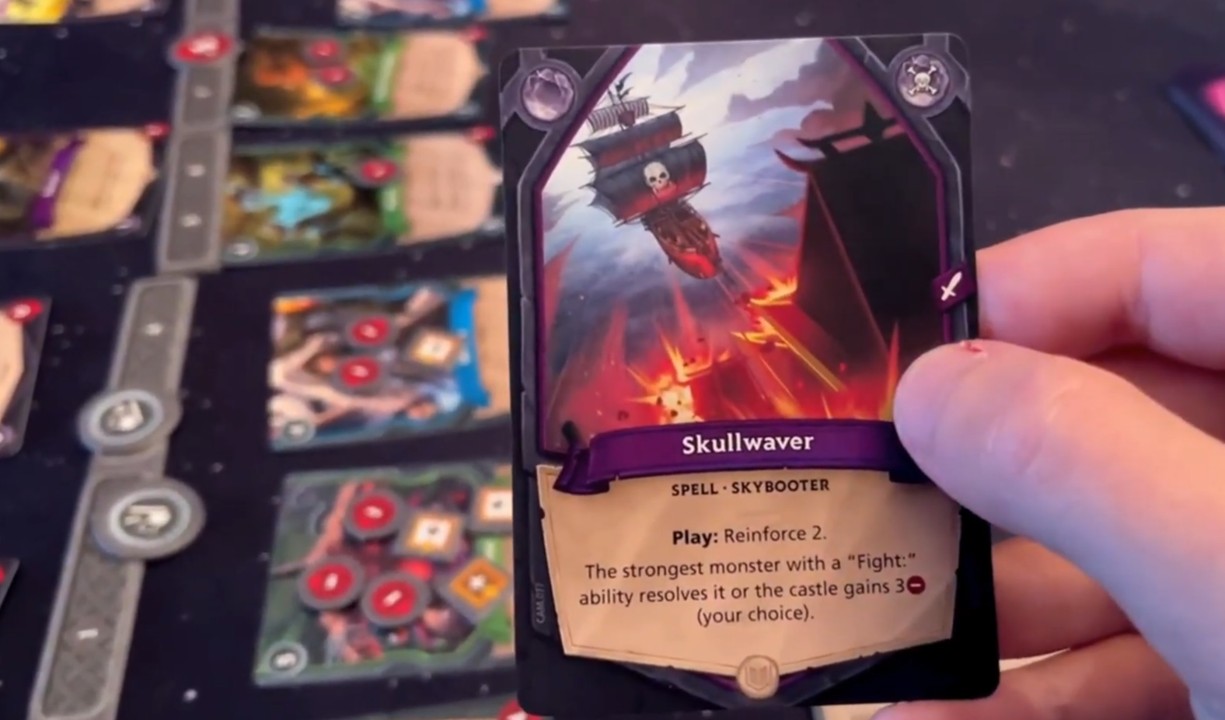
The game comes with cards…lots and lots of cards…as well as various tracker tokens.
The player will choose either a premade alliance deck or assemble their own following the deck-building rules outlined in the rulebook. There are four factions…blue, red, green, and yellow, however yellow doesn’t appear to be in this particular set. It’s suggested that players use either the blue or green deck for their first game. The player also gets a castle card that matches their faction color.
The player will be aiming to defeat the outsider in order to win, but lose if either their castle is destroyed or their alliance deck is empty.
The game will be spawning waves of monsters at the player via a portal card. This portal card rotates every round determining how many monsters spawn and how many minions get reinforced. By destroying the first portal card (there are many and of varying difficulties), the player will summon the outsider to the battlefield to attempt to take it out.
Minions are a different kind of threat that are ALWAYS present, representing the “redshirts” of the Horde army that are separate from the monsters found in the horde deck. Luckily the player can lure these these minion groups to the front line and keep their numbers under control as they will pillage (discard) cards from the player’s draw deck if left to sit on the back line.
Combat takes place in lanes. The player and game alike will be summoning heroes / horde cards to these lanes and ultimately do battle. The player has a limited amount of mana at their disposal used to play cards to these lanes.
The game is played over a series of rounds, consisting of a Horde Phase, Alliance Phase, Treachery Phase, Fight Phase, Pillage Phase, and End Phase. Rounds continue until either the player or game wins. The cooperative mode plays just like the solo mode with very few differences here and there, nothing hard to understand or pick up.
Once players are comfortable playing a one-off game, they can opt to play a campaign spanning four games in typical rogue-like faction.
You can find the rulebook here for a complete listing of the rules.
—
The Review
I love card games like these that allow a player or a gamer couple to match their wits (and luck) against an AI opponent. Like every semi-complex / complex card game of this sort, there lies that stubborn rule or five that you just can’t find in the rulebook to tell you how something is resolved. We did that regularly and while we appreciated the rulebook’s semi-thoroughness, it missed the mark in explaining specific situations / cards.
I personally had an issue with the difficulty, feeling it was overtuned for a new player. Despite me setting up the game on the easiest difficulty, we nearly lost our first game. I have a few different home-brew ideas that I fully intend to implement the next time we play.
For starters, your deck is your life force. It doesn’t reshuffle. You run out of cards, you lose the game. I’d homebrew something to either allow a 1-time reshuffle OR allow more opportunities to move cards from the discard back into the deck, perhaps as a reward for defeating a monster and every portal. One extra mana per round would be helpful, as would spawning less minions and horde cards. There are many opportunities to fine-tune the game if you’re willing to be creative.
The lane mechanics worked well and we loved the positional aspect of it. While it exhausts cards to move them around (preventing you from using their card abilities), doing so may very well save an important character from death in the upcoming combat round. Since decks do not reshuffle, we had to take each and every card / character loss seriously…more-so than we would say “Star Realms” or “Star Trek: Captain’s Chair”.
Aidalee, despite not understanding the game right away, enjoyed her time spent and then some. She likes a steeper challenge more than I do, so I felt like she was right at home and in her wheelhouse. She praised the art, the quality of the cards, and how cool the different factions worked. You can see more of her comments in the Cozy Game Night video below.
I too am smitten with this title, in between bouts of frustration that is when I can’t immediately figure out how some card ability is supposed to work. I get that there’s a learning curve but I hate having to go online looking for answers in the middle of a session…it just breaks the immersion. That’s really my sole complaint, aside from the lack of easier beginner mode settings (which I just as easily fixed with home brewed rules). Everything else is fantastic and the box has lots of space for other cards and expansions.
This is a wonderful game…quirky and unforgiving sometimes, but fun nonetheless.
—
Score: 8/10 (Great)
—