
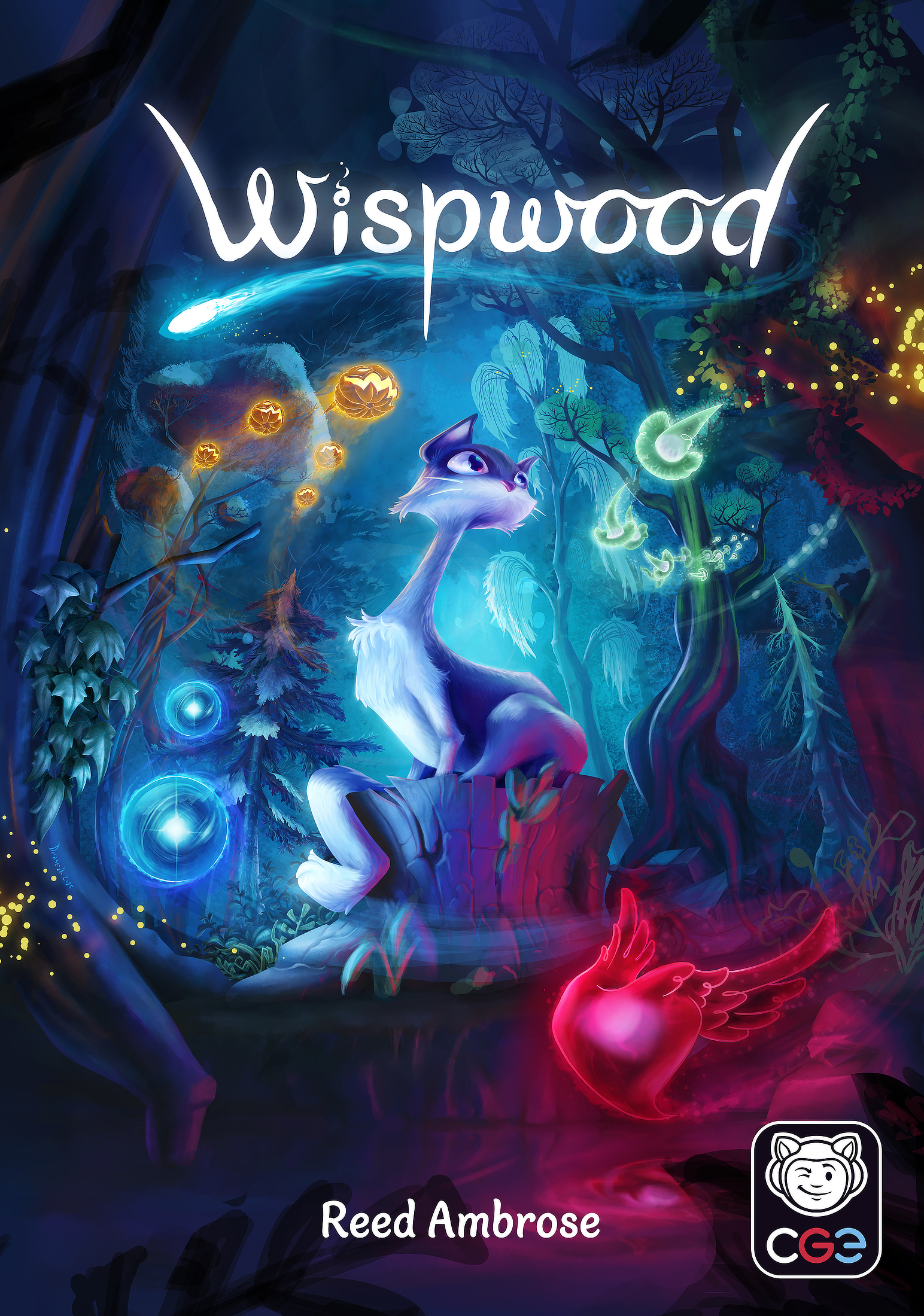
Fancy a little “Patchwork”? Or perhaps a little “Cascadia” or “Kingdomino”? “Wispwood”, a charming little game for 1-4 players, has a bit of all of those tabletop games with a nice, free scoring app to go along with it. In “Wispwood”, players will be drafting wisps of different colors and forming tetromino pieces to score the most points in their personal grids. Special thanks to the folks at CGE for providing a press copy of review purposes.
—
Game Overview
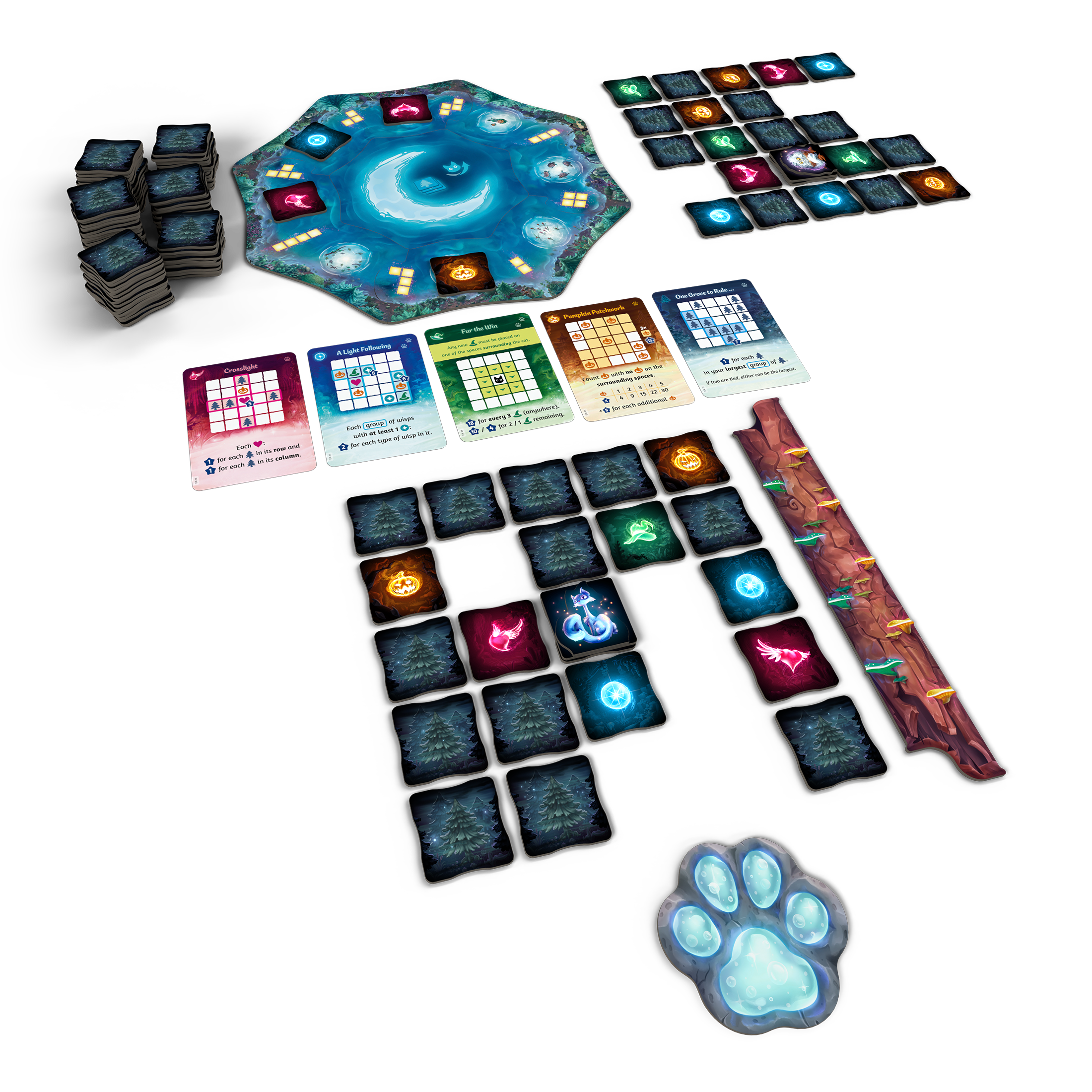
Players start by choosing a face-up cat token (purely aesthetic) to start their personal grids. They’ll also choose 5 of the 25 available scoring cards, one of each color. The tree / wisp tiles are shuffled and they’re all stacked tree-side up, then players draw enough wisp-side up to fill the circular pond board. Players can optionally use the grid aids available to keep track of the dimensions in their grid.
The game is played over 3 rounds. In round 1, players will be forming a 4×4 grid. In round 2, players will be aiming to complete a 5×5 grid. Lastly in round 3, players aim to complete a 6×6 grid. A round is over when one player fully completes their personal grid with all players finishing the round so that everyone has had an equal number of turns.
At the game start, players begin with just the cat tile in their grid. On their turn, they’ll choose a wisp tile from the pond, then a tetromino piece shape on either side of it. They’ll use the face-up tree tiles to fill out the shape they’ve chosen, incorporating that one wisp into that shape. Alternatively, they can flip their cat token from the active side to its spent side to break a few rules. There’s also a tree action available that allows players to ready their cat token and fill in their grid with 1, 2, or 3 tree tiles…best to fill in donut holes that normal shapes can’t fit into.
While players are doing this, they’ll be observing the point conditions on the 5 scoring cards chosen for the game. Placement of your wisps will be key to getting them all to jive together. What’s crazy is that at the end of the round, right after scoring, all tree tokens go away and the wisps remain where they are…this means you’ll be trying to work around wisps from the previous round(s). Luckily, as stated earlier, the grid size increases every round.
—
Review
Aidalee and I were both very impressed by “Wispwood”. The game is incredibly simple to learn and one that I’d happily introduce to a newcomer in the tabletop game world. I think its depth comes from the fact that not only are you trying to get available wisps in the pond to position themselves correctly in your grid to store points, you’re forced to observe the shapes they are next to (unless you flip your cat to pick ANY shape).
The most challenging part of this game however was realizing that once a wisp is positioned, it’ll stay there until the rest of the game. You have to work around them and find a good way to do so without compromising how they were earning you points in the previous round. The red wisp, in our game as an example, scored for every tree in its row or column…but over the game I was adding more and more wisps to the grid and tried hard to keep the tree tiles in relevant spots to continue to score as I had before.
I have a feeling that players attempting this game for the first time will get tripped up by this. Luckily, the game finished fast enough to try again in a new game, hopefully with a better understanding of how the wisps and tree tiles flow from round to round. There’s a solo mode as well that I intend to try in the future, time permitting.
“Wispwood” has that satisfying mix of the games I like, especially the aforementioned “Kingdomino” (tile / grid-laying), “Patchwork” (tetrominos), and “Cascadia” (inter-changeable scoring cards). It’s sharp colors make it easy to look at too! This one is an easy recommend.
—
Score: 9/10 (Outstanding)
—
https://youtu.be/VH0KyuG7bJI