
Released in 1991, “Street Fighter 2” was probably one of my favorite arcade games, even when “Mortal Kombat” made its debut as a serious contender a year later in 1992. I had more of a connection with Ryu, Ken, Guile, and the others compared to Liu Kang, Kano, and etc. “Yomi” seems to have a relatively rich history, dating back to 2011 per BoardGameGeek. Admittedly, the “Yomi 2” products are my first adventure into tabletop / card fighting games in quite a while. On that note, special thanks to the Yomi 2 Marketing Team for reaching out and providing copies for coverage purposes.
—
Products Overview
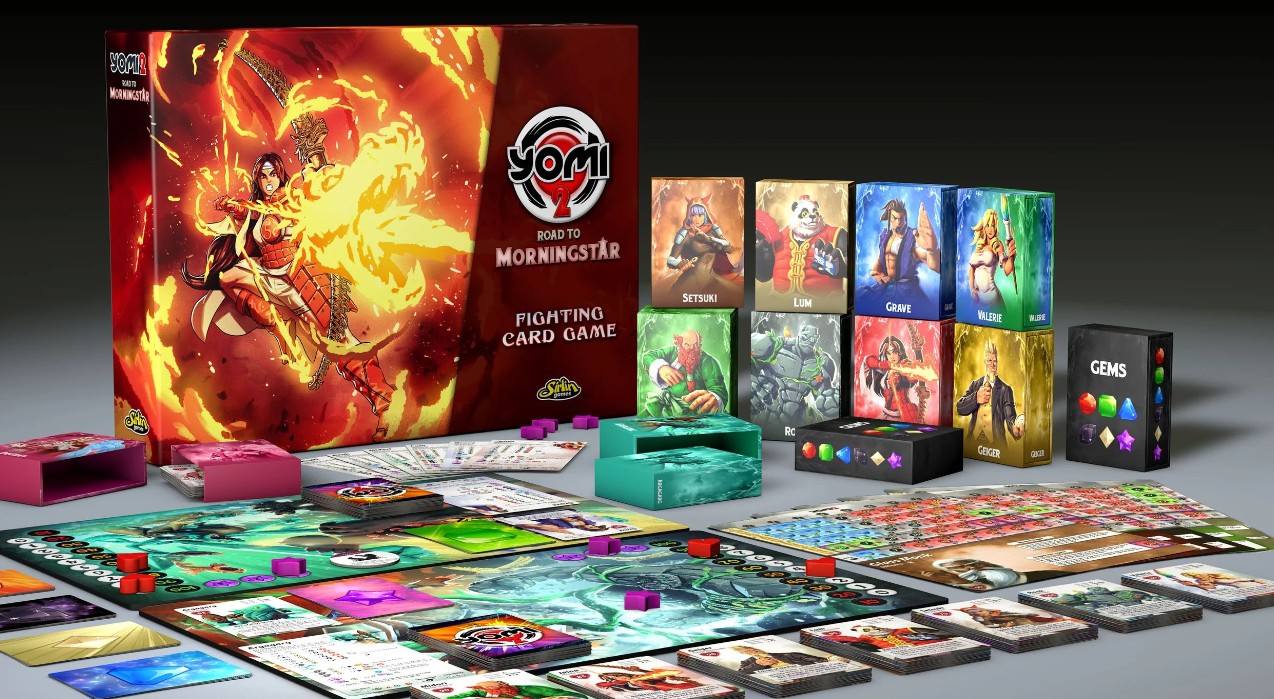
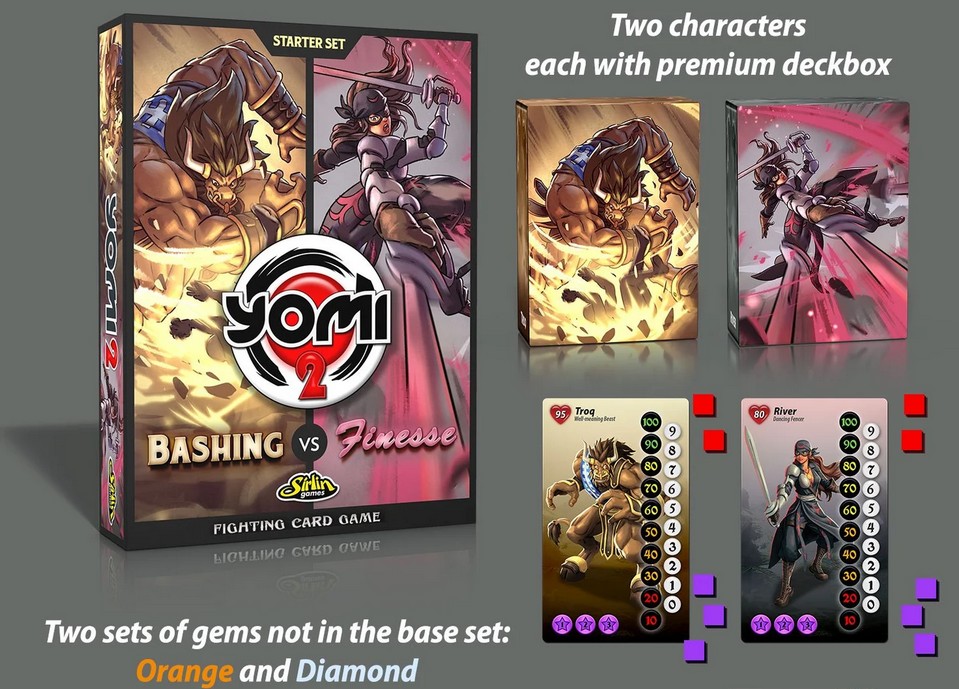
I received a copy of “Yomi 2: Road to Morningstar” and “Yomi 2: Bashing vs Finesse”, as well as a generous supply of card sleeves.
“Yomi 2: Bashing vs Finesse” is labeled as a starter set, including two character decks as well as an orange + white gem deck for each. More on gem decks later. Cube tokens and guide cards round out the kit. This is purely a 1vs1 experience, but includes everything you’ll need to understand the gaming system / mechanics.
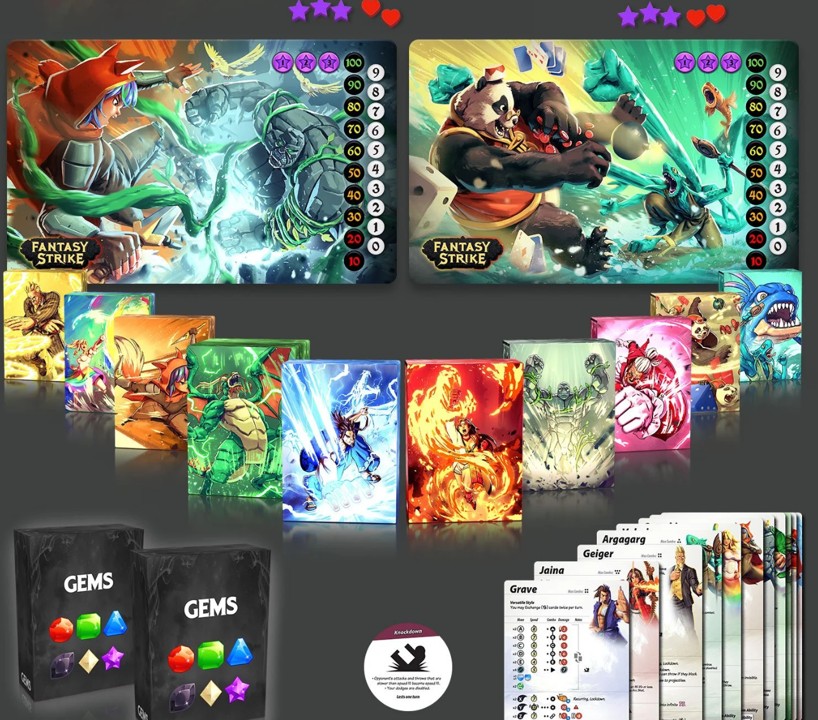
“Yomi 2: Road to Morningstar” is grandiose in size, including ten characters decks, two neoprene mats, heart / star tokens as opposed to cube tokens as featured in the starter set, guide cards, AI sheets & an eight-sided die for solo / co-op modes. Yes, this game can be solo / co-op in addition to the 1vs1 experience.
To see what all that looks like, check out the unboxing video featured at the end of this article.
—
—
Gameplay Overview
While the rulebooks are available online, I’ll briefly sum up gameplay by saying that it is a quick paced, yet tactical card game that features a rock / paper / scissors mechanic. Players decide a game mode (solo / co-op is available in the Road to Morningstar set) and then choose a character. In addition to getting a unique character deck, they’ll get to pick one gem color and include the associated cards along with their character deck.
Cards are mostly broken up into attacks, throws, and blocks…however there are special cards that come into play based on the character deck and gem deck chosen.
During a round, the active player draws cards, can perform an exchange from their discard pile, use their special gem power, and other actions. They’ll then play a card face-down, with their opponent following suit face-up, with the active player then flipping their card over to see who won.
Attacks beat throws, throws beat blocks, and blocks / dodges beat attacks, however there are exceptions. For example, high blocks will not stop a low attack, and vice versa. Dodge cards act like blocks, but allow the player to counter-attack with another card from their hand. Damage is not simultaneous, meaning the winning card usually completely nullifies the other. Again, there are exceptions.
Cards also have an identifier for combos. Cards typically list what they are and what they can be combo-ed into. If an attack hits, the winner can continue playing extra cards so as long as they have enough combo points and the cards played combo off of each other properly.
There’s more, so I encourage you to check out the videos below for more information.
—
—
The Review
We’ll start and finish quickly with the “Bashing vs Finesse” starter set. It’ll provide everything you’ll need to get yourself started, along with both a white and orange gem deck. My only concern really is the longevity and replayability. After five or ten playthroughs, you’ll probably be wishing for new characters to play with / against along with a solo mode. I recommend it to those on a budget who want to see how the system behaves first, as the “Road to Morningside” is roughly four times the cost.
Moving on to “Road to Morningside”, I love the variety of characters available in this set. The box is on the larger side for ten character decks, but with the addition of the neoprene mats and other components I can see why they went that route. The art is *chef’s-kiss* outstanding…I wasn’t sure who I wanted to play first when I opened the box.
The solo / co-op mode is implemented well, but it seems to be more about playing odds compared to an actual 1vs1 against a live person. You see, the AI has a hand size you’ll track as it does stuff, and will roll an 8-sided die to see whether it attacks, blocks, throws, or whatever. Most of my time was spent going, “so there’s a 2/8 chance he’ll attack, a 4/8 chance he’ll block…”, so I was constantly just playing cards that gave me the best shot to succeed. Each of the 5 AI characters have a difficulty and special abilities, which helps to break things up. Besides “Bullet” and “Dice Throne”, I haven’t seen AI characters this thought out and unique.
I only had two complaints with the “Road to Morningside” product. Firstly, the guide cards came wedged tightly in a slot made into the insert. The slot was not long enough, so the guide cards were slightly bent. I’m either going to have to make the slot longer, or simply find another spot for the guide cards. Secondly, and this is a minor quibble, I would have liked a separate health tracker and few more heart tokens for the bot as both neoprene mats are used in co-op play. We ended up using a calculator to track bot health but again, not a big deal.
Overall, we enjoyed our time with this title. The rules can be slightly finicky in some places as you’re attempting to understand how all the effects, rules, and timing come together. That said, “Yomi 2” gave me a nostalgia trip that I hadn’t felt for quite a while. I almost attempted to find my SNES and hook it back up so that I could play “Street Fighter 2” all over again. The price is a bit steep for the “Morningside” box, so I highly recommend the digital version or the starter set first.
—
Final Verdict: 8/10 (Great)
—