
Most rodents are nocturnal (mostly active at night) and while I’ve never had the pleasure of owning one, I’ve experienced the endless “squeak squeak” of the hamster wheel during overnight stays at a friend’s house back in grade school. I’ve not had a whole lot of experience with mice, aside from the cartoons I’ve seen on TV. Luckily, with “House Mouse”, a board game shipping 10/15/2025, no experience is necessary to jump in and start scavenging. Special thanks to the folks at Sodalite Games for providing me a copy for review purposes. I’m required by FTC regulations to disclose that I was paid to cover this game, but any and all opinions remain my own. As always, the only thing paid for here was my time and 15 years of experience.
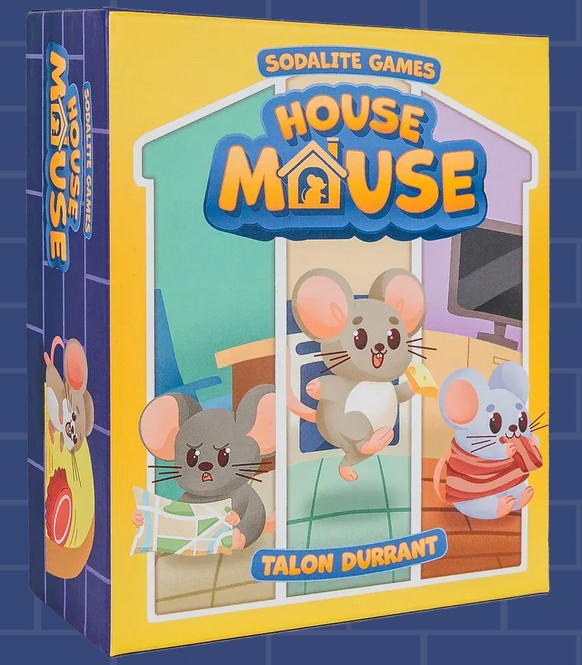
2-8 Players, Ages 8+, Average Play Time = 15-30 Minutes
—
Overview
At its heart, “House Mouse” is a take-that-ey, chaotic, point driven card game that puts players in the shoes of mice who are tasked with scavenging various things around the house. The idea is to build your “nest” of cards quickly and favorably, aiming to have more points than anyone else when the game ends.
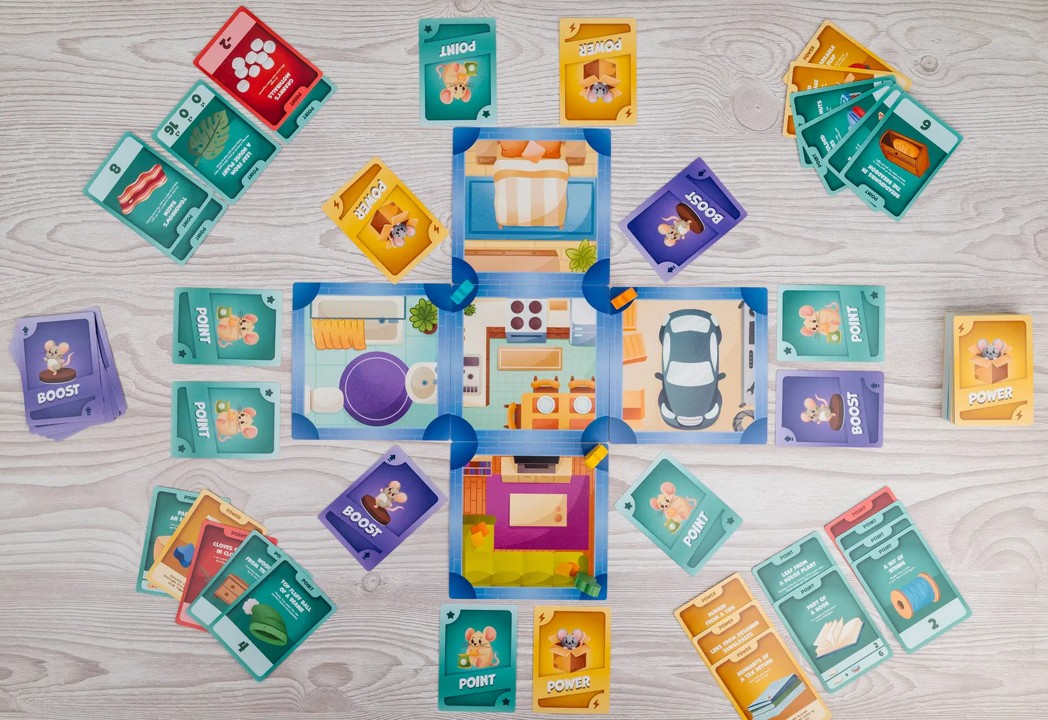
Player count will change the setup rules quite a bit so I’ll offer the 2-3 player version. They’ll start by laying out 3 room cards face up in a row and including Basil in a 2 player game. Basil is essentially an extra game NPC that runs around the house and scavenges to keep things tight. The deck of point, power, and boost cards are shuffled to form a single deck, with a card being dealt in each of the room corners (8 cards in a 2-3 player game). Players choose their mouse, and off they go!
Play starts with the player who last saw a real mouse with turns proceeding clockwise. Starting with the last player and in reverse turn-order, each player places their mouse on any unoccupied room corner. In “House Mouse”, room corners serve as the spaces in which players traverse throughout the game.
A player gets 3 actions on their turn and can do any of the following in any order:
1. Scavenge – Add the face-down card near the active player’s mouse to their nest. The nest is the area in front of a player and is considered open information (the cards are face-up). This card is not replaced immediately.
2. Move – Move from one corner to another adjacent corner. You can move to the opposite diagonal corner in the same room. If the space a moved from does not have a face-down card present, one is drawn and placed there after the move is complete.
3. Activate a Power – The active player can activate a card in their nest to resolve its effects, though each card can only be activated once per turn unless it changed nests. Power cards that were just acquired during a scavenge action can be played for free for that moment only.
Boost cards are one-time use cards and do not cost an action to play. In fact, they can be played on anyone’s turn. They do not count toward a player’s 12-card nest limit.
Speaking of which, the game ends immediately when a player has added their 12th card to their personal nest (they may activate it for its power effect first if viable). Points are tallied across everyone’s nests and the person with the most points, wins!
It’s important to stress that I didn’t cover all of the rules found in the rulebook, but the above should give you an idea as to how the game is played. For your convenience, I linked the rulebook below.
Rulebook: https://www.sodalitegames.com/games/house-mouse
—
Review
“House Mouse” (not to be confused with “House of Mouse”), is incredibly colorful and eye-catching. For a simple card game involving mice and victory points, I found my eyes darting from one end of the table to the other. I wasn’t expecting it to have the table presence that it does, but the art is very well done the colors pop.
While the developer could have made all the cards have the same back so that you didn’t know what card types were where, I’m incredibly glad that he didn’t. When you’re looking at the board and see a room full of point card backs its incredibly tempting to rush in there and gobble them all up (or whatever mice typically do). Knowing where the card types were but not what the face-up side contained gave me a bit of decision paralysis, but in a good way.
I also wasn’t expecting this game to turn into a light engine-builder either. Power cards, when acquired, can be used once per turn (even for free when first-acquired). This makes acquiring them incredibly tempting early-game, for the more rounds you can use them, the more powerful they end up becoming. I almost wanted to forgo earning points just to create an arsenal of powers that ruined everyone’s day. One card I found to be incredibly powerful was the sunglasses, which lets you look at face-down cards around the house…great for avoiding negative point cards.
Speaking of points, they’re not just “plus this” and “minus that”. While there are positive and negative point cards, there are also collection cards which reward you for having multiples of that same card, as well as combo cards which are worth some points alone but worth more points paired with their listed counterpart. All of these different ways of earning points makes the game slightly more cutthroat, I feel, as you’re often eyeing what your opponents have and figuring out how to get what you need from them without relying on drawing blindly from the rooms.
Basil, as mentioned earlier, is an AI player that behaves on its own. While he’s not a mandatory addition, I highly recommend using him on lower player counts to keep things cycling around the house. Basil won’t scavenge power or boost cards and prefers to amass point cards…yes, he can trigger the end of the game as well as win.
I did have one small quibble, and that was lack of any particular reason to traverse the length of the board aside from going after particular card types. If the deck is shuffled well, there’s a good chance you’ll have a variety of card types near you, so I often just went back and forth between 2-3 spaces without ever going near my opponent. While you DO interact with others via card abilities, there seems to be no encouragement to fight for particular board spaces unless it’s the only point card available and both players desperately need one (very rarely does this happen). I’m not sure how to solve this aside from randomly placing space bonuses throughout the game…as I said, it’s a small quibble. There are plenty of board games where players don’t directly interact (“Alhambra”, etc.) and they do quite well, so some may like this and some may not.
The only thing missing is an official solo variant. While I haven’t play-tested one, I imagine it wouldn’t be too difficult to play against multiple AI mice (Basil + Jerry + Mighty Mouse + etc.) and fight for victory points. You’d have to experiment a little for balance purposes, but I’m sure it can be done as I’ve created solo variants for games more complex than this. There’s a huge solo tabletop community out there, so this feels like a missed opportunity.
While I would normally be hesitant to pay over $15-20 for a card game, I am reluctantly forced to finally admit that we’re now living in 2025 and not 2010. The game is normally priced at $28, but can be purchased for $22 during a special pre-release promotion until October 14th, 2025. The price, I feel, is fair for the amount of content provided. There are a lot of cards and by extension, powers, that cycle out from one game to the next. Games, from one session to the next, feel exciting and fresh.
Box Quote: “House Mouse” is colorful, chaotic, and punchy. It supports a wide range of players (2-8) and is appropriate for people of almost any age, making it incredibly versatile for any situation. Since there are heavy “take that” mechanisms in play here, parental guidance is suggested.
—
Score: 8/10 (Great)
—
Website: https://www.sodalitegames.com/games/house-mouse
Buy: https://www.sodalitegames.com/releases/house-mouse
—